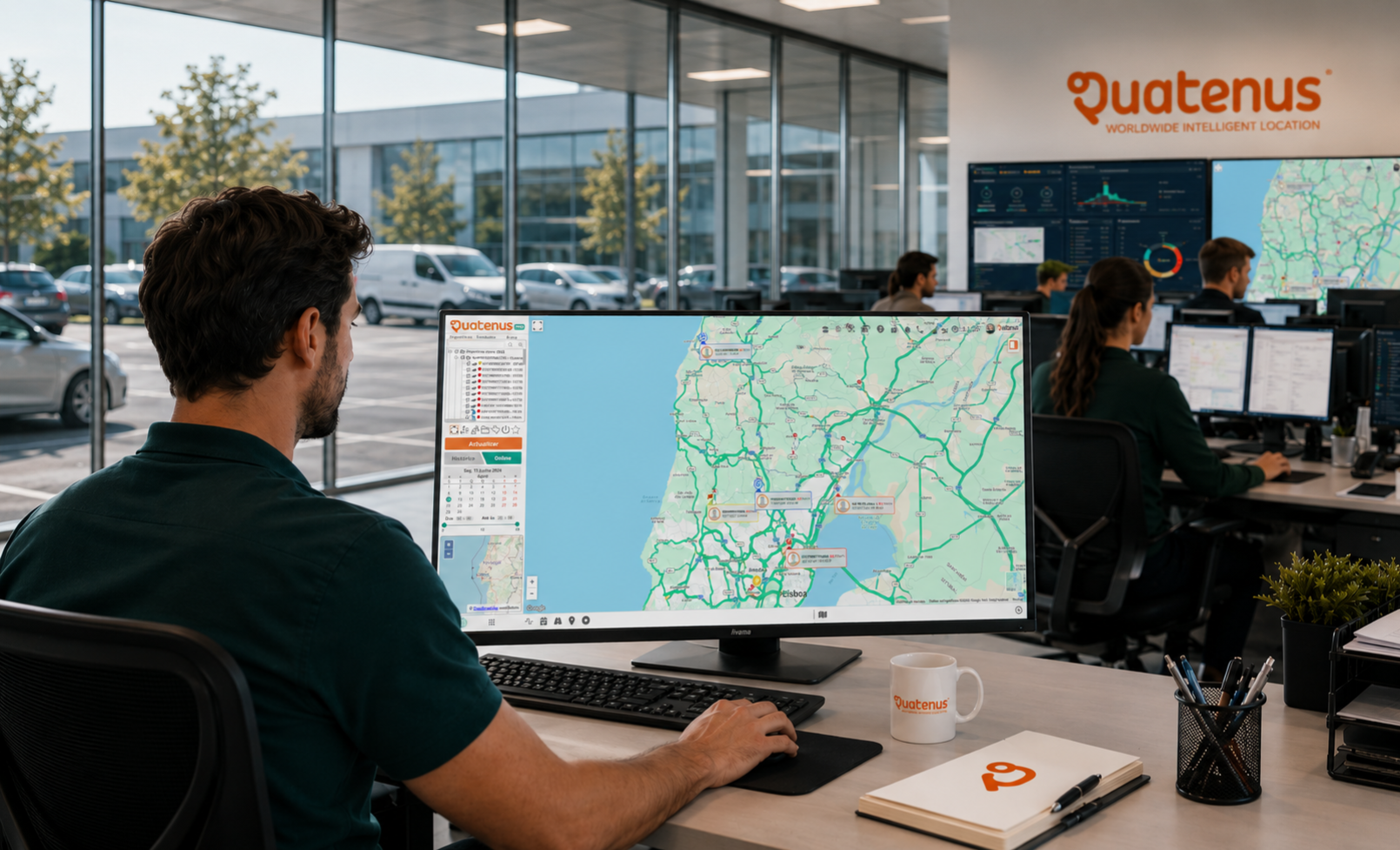
When a company looks for a vehicle tracking system, the first promise often sounds simple: seeing the fleet on a map. In practice, however, fleet GPS location only has value when it supports better decisions.
If a vehicle appears in the wrong place, if a route is not recorded or if an alert arrives too late, the issue is no longer just technical. The operation loses trust in the data, the team reacts later than expected and management lacks a reliable basis to interpret deviations, incidents or uncertainties in the field.
Assessing a tracking system before purchase requires more than checking whether real time location is available. It is important to understand how the system records movement, how it deals with unstable signal areas, what types of alerts it provides, how it presents route history and whether the data truly helps turn information into action.
Real time location is often treated as a basic feature. The vehicle appears on the map, the manager follows its movement and the team assumes the information is correct. The issue appears when what happens in the field does not match what the system displays.
A delayed position, an incomplete route or a vehicle shown in the wrong place can lead to fragile decisions. The manager may contact the wrong person, assume a job is about to be completed, interpret a deviation as non compliance or miss an incident that required immediate action.
These situations can result from several factors: equipment quality, incorrect installation, areas with poor coverage, update intervals that are too long, poorly configured alerts or lack of route history validation. The key point is that location should not be assessed only by the presence of a dot on a map, but by the level of trust that dot gives to the operation.
A vehicle tracking system should help answer specific questions. Where is the vehicle? Which route did it take? How long was it stopped? Were there deviations? Did the alert arrive on time? Does the recorded information make it possible to confirm what happened afterwards?
The difference between a limited tool and a useful platform lies in its ability to turn location into operational visibility. Seeing vehicles on a map is only the beginning. Management needs context: movement sequence, time spent at each point, route replay, events linked to the journey and records that support decision making.
Before purchase, the company should test accuracy in scenarios close to its real operation. A demonstration in controlled conditions is not enough. It is important to understand how the system behaves in dense urban areas, industrial zones, long routes, locations with lower coverage and situations involving multiple stops.
Accuracy should be assessed through the system’s behaviour over time, not through a single view. The company should confirm whether the vehicle position is updated at an appropriate frequency, whether routes are recorded consistently and whether there are significant differences between real movement and the history displayed.
Alerts should be configurable and useful for the operation. An alert that arrives late or lacks context can create noise instead of helping. The company should assess whether the system allows relevant events to be defined, such as entering or leaving zones, unexpected stops, route deviations or use outside the expected schedule.
Route history is essential for later analysis. When there is uncertainty about a route, a visit, a stop or an incident, the team needs access to clear information. Route replay, times, stops and associated events help reconstruct the operation and reduce decisions based on memory, calls or scattered messages.
Validation should start with real scenarios. A company working with technical assistance, distribution, sales teams or field services should not assess the system only through a simple route. It should test routes with repeated stops, busier areas, different schedules and situations in which response speed matters.
It is also useful to compare what the system shows with known operational records. For example: a planned route, a confirmed visit, a scheduled stop or an arrival at a specific location. This comparison helps identify whether the information displayed is accurate enough to support daily decisions.
Another important point is to involve the people who will use the data. Management teams may value reports and indicators, while operational managers may need fast alerts, clear maps and route history that is easy to consult. A technically complete system can lose value if the information is not simple to interpret at the right moment.
A well assessed vehicle tracking system does not only locate assets. It creates operational trust. When data is consistent, the team no longer depends only on calls, manual sheets or scattered messages to confirm where a vehicle is, which route it followed or which event requires attention.
This trust affects how the company manages deviations, responds to incidents, analyses productivity and communicates with customers or field teams. Visibility stops being a visual promise and becomes real decision support.
For that reason, the choice should not be based only on price, map appearance or a long list of features. It should consider information quality, alert clarity, route history reliability and the ability to turn data into safer decisions.
Before moving forward, the company should question how the system updates location, what information remains available when there is temporary signal loss, how alerts are configured and whether the history allows routes to be reviewed in enough detail.
It should also understand whether the platform helps distinguish simple vehicle viewing from a more complete operational view. The goal is not only to know where something is, but to understand what happened, when it happened and what decision should be made next.
Want to better assess accuracy, alerts and route history across your fleet?
Speak to Quatenus and discover how a monitoring platform can support clearer decisions in daily operations.
Ask for DemoFAQ
It is a solution that makes it possible to monitor the location, routes and events associated with vehicles. Its value depends on data accuracy, alert usefulness and how easy it is to consult route history.
Inaccuracies may be linked to signal coverage, equipment quality, installation, update frequency, platform configuration or the way data is recorded and displayed.
Because the position on the map is not always enough to explain the operation. The manager needs context, history and organised information to understand what happened and decide with confidence.
It depends on the operation, but relevant alerts may include entering or leaving zones, unexpected stops, route deviations, out of hours use or events requiring a fast response.
No. Seeing vehicles on a map is useful, but management also needs to interpret routes, clarify doubts, confirm incidents and review information that supports decisions.
Quatenus treats location as part of a management process. Fleet information is organised to help the manager monitor, analyse and decide with greater clarity.
Beyond real time location, you should assess whether the system helps review history, interpret routes, identify relevant events and reduce manual checks.
The value lies in turning location into useful information. When data helps explain the operation, the team makes better decisions and manages with greater confidence.
Related